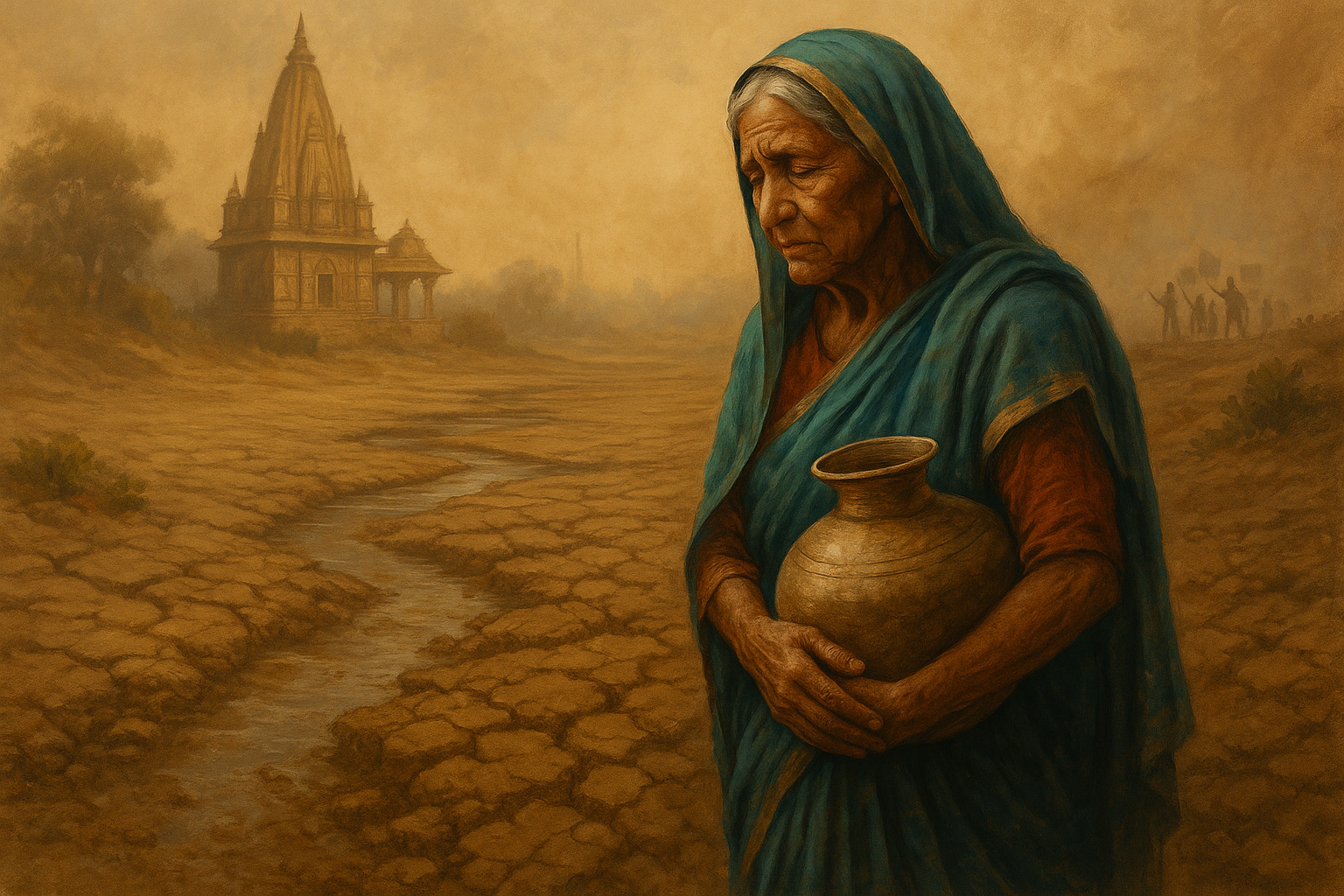
Every time I pass the once-lively Bindal River near Dehradun, I’m struck by its silence. The gentle current that used to carry schoolchildren’s paper boats now carries only debris and sorrow. This story isn’t just local—it echoes across India. From the Ganga in Varanasi to the Cauvery in Tamil Nadu, our rivers are dying. And with them, a part of our identity.
We often call rivers our lifelines. But today, these lifelines are choking—from pollution, dams, sand mining, and altered rainfall due to climate change. We are not just losing water—we’re losing worship, livelihoods, memory.
Rivers Are More Than Geography
India’s rivers are more than physical features; they are cultural and spiritual arteries. The Ganga is revered as a goddess. The Yamuna flows through thousands of years of poetry. Rivers are tied to birth and death, rituals and resistance.
But in 2024, the Central Pollution Control Board found that over 351 river stretches in India are polluted beyond safe limits—most with faecal contamination, plastic, and industrial effluents. The Yamuna in Delhi, for example, is now ecologically “dead,” unable to support aquatic life in many stretches.
“The river is no longer flowing,” said a boatman I met in Rishikesh last year. “It’s being carried in pipelines.”
Why Are Our Rivers Disappearing?
1. Climate Change & Glacial Retreat
The Himalayan glaciers that feed India’s rivers are melting at unprecedented rates. A 2023 report by ICIMOD revealed that glaciers in the Hindu Kush Himalaya could lose up to 80% of their volume this century if emissions continue unabated. (Source: ICIMOD)
2. Over-extraction & Damming
India is the world’s largest extractor of groundwater. In Uttarakhand alone, rapid urbanization has led to unregulated borewells and river diversions. The construction of mega dams—like the Tehri Dam—has drastically altered flow and sedimentation patterns.
3. Pollution & Encroachment
Rivers have become waste channels. The National Green Tribunal has repeatedly fined states for failing to prevent untreated sewage from entering rivers. Religious festivals add to this, ironically in the name of reverence.
4. Sand Mining
Illegal sand mining, especially in rivers like Chambal and Yamuna, disrupts aquatic habitats and collapses riverbanks. The mafia controlling this trade operates with impunity.
Stories of Hope & Resistance
- In Assi Ghat, Varanasi, local women have formed self-help groups to clean stretches of the Ganga every week.
- The Revive Yamuna campaign by eco-activist Manoj Misra has planted thousands of saplings and educated children about river ecology.
- In Meghalaya, communities have restored spring systems and protected catchment areas using traditional laws.
In Dehradun, where the Rispana River had nearly dried out, a citizens’ group started the Rispana Restoration Project, planting native species, clearing encroachments, and involving school kids in cleanup drives. I volunteered there last monsoon—seeing young hands plant saplings felt more sacred than any ritual.
What Can We Do?
- Support or volunteer with organizations like Ganga Action Parivar or TERI.
- Avoid idol immersions and chemical-laced rituals in rivers.
- Push for stricter implementation of the Namami Gange program and demand transparency.
- Conserve water daily—every flush or faucet eventually affects flow.
A River Is Memory
Our rivers are not gone—not yet. They are waiting. For respect. For revival. For rain. But also for resolve. And in this, we have both the duty and the power.
When I take my daughter to the forest and show her a stream, I want her to see a river that still breathes—not just one remembered in textbooks. Because when a river dies, it doesn’t just take fish or frogs—it takes stories. It takes futures.
Suggested Read:
Why Monsoons Are Changing – And What That Means
Sacred Groves: Nature’s Forgotten Temples














No responses yet