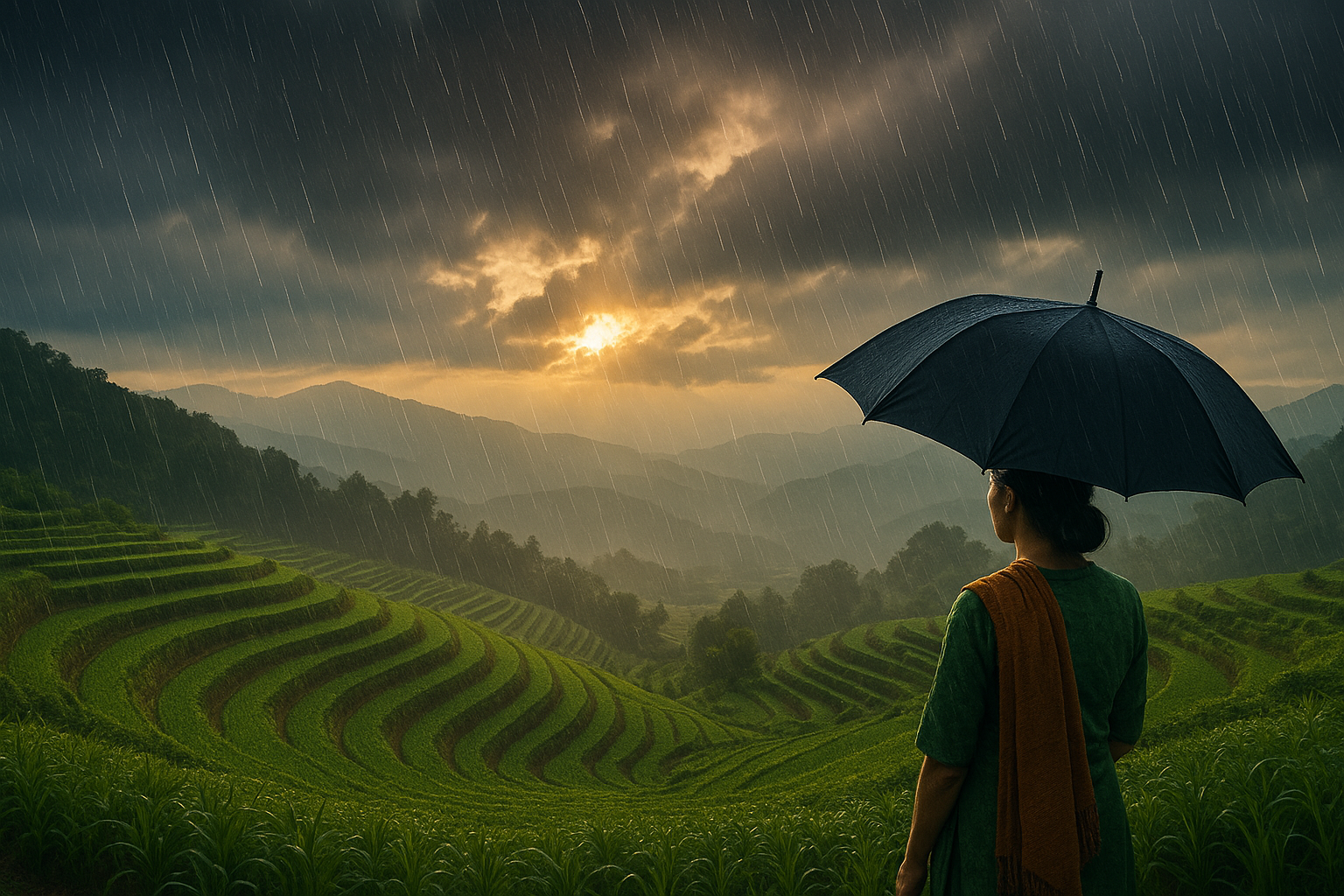
Monsoons in Dehradun have always had a rhythm. The scent of parched earth soaking in its first rain. School half-days. Frogs croaking in harmony with swollen rivers. It was a season that arrived with predictability—and poetry.
But something has shifted.
Over the past decade, the monsoon has begun to speak in new, erratic tones. Torrential downpours followed by long dry spells. Flash floods in June, drought in July. A season once known for gentle persistence now crashes in and disappears like a tantrum. The monsoons are trying to tell us something. Are we listening?
A Climate Out of Balance
India’s monsoon is powered by a delicate dance between land, sea, and air pressure. But human activity has thrown this ancient choreography off balance.
The India Meteorological Department (IMD) reported in 2023 that while total monsoon rainfall has remained relatively stable, its distribution has become wildly uneven. This means more extreme rain events—what used to fall over a week now falls in a single day, overwhelming both soil and infrastructure.
“These are not just freak years anymore. This is the new climate normal,” says Dr. Roxy Mathew Koll, climate scientist at the Indian Institute of Tropical Meteorology.
Source: Down To Earth
Ground Reality in the Himalayas
In Uttarakhand, where the mountains meet the monsoon, the cost of this shift is especially high:
- Landslides have increased by over 250% in the last 15 years.
- Glacial melt + extreme rainfall is causing flash floods in Chamoli and Rudraprayag.
- Farmers face rising anxiety as sowing windows become unpredictable.
In 2021, I met Mala Devi, a farmer near Mussoorie. Her family lost half their rice crop after a dry June and a sudden hailstorm in July. “Pehle barish bharosa thi. Ab dar lagta hai,” she said. “Rain used to be reliable. Now, it’s terrifying.”
Science Meets Soil
Climate models from the IPCC AR6 predict:
- Shorter monsoon windows
- More frequent cloudbursts
- Increased rain-induced disasters
These aren’t future projections—they’re present realities. Even in urban Dehradun, streets flood within hours due to 100 mm downpours. Groundwater recharge suffers when prolonged dry spells follow.
Adapting to the Uncertain
The good news? Communities are adapting. Slowly, but with resolve.
- Kerala: scaling rainwater harvesting at the ward level
- Sikkim: farmers adopting water-efficient crops
- Almora: youth-led initiatives training locals to monitor rainfall
Here’s how we can act:
- Support Arghyam Foundation for water conservation.
- Follow BAIF Development Research Foundation for resilient agriculture.
- Speak up for forest protection—it buffers against runoff and erosion.
- Push for climate adaptation in local government planning.
Listening Again
The monsoon was once a teacher, a storyteller, a companion. Today, it has become a warning siren. But it still carries a message: nature is shifting, and we must shift too—not in fear, but in preparation.
This year, as thunder cracks across the Doon valley, I hold my daughter close and remind her: the clouds are not angry. They are confused. And we must help realign the rhythms we’ve broken.
Suggested Readings:
India’s Vanishing Rivers – A Crisis of Flow and Faith
Climate Change Is Already Here—Just Ask the Himalayas














No responses yet