Bengaluru's Wild Edges
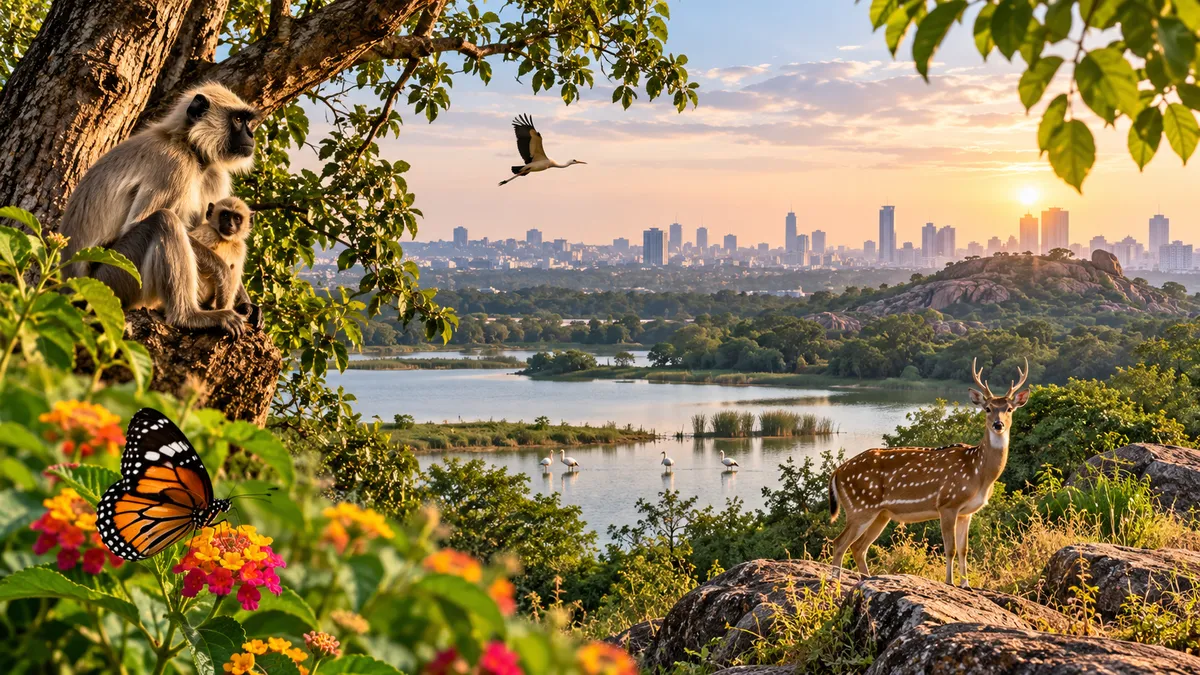
Bengaluru is usually described as a city that has lost its nature. The evidence is more complicated. A year-long camera-trap survey by the Holématthi Nature Foundation estimated 80 to 85 leopards in and around the city in 2025, 54 of them inside Bannerghatta National Park. What decides whether that wildlife survives is not the core of any forest but its edges, where farmland, quarries, roads and housing meet scrub, grassland and lakes.
Bannerghatta and the width of a buffer
Bannerghatta National Park covers 260.51 sq km on the city's southern border. In 2016 the Union environment ministry proposed an Eco-Sensitive Zone (ESZ) of 100 m to 4.5 km around it, totalling 268.96 sq km. The final notification in March 2020 cut that to 100 m to 1 km, or 168.84 sq km, while banning commercial mining, quarrying and stone crushers inside it. Activists have since documented resorts and new layouts around the park, including a housing layout on land the 2016 draft would have covered, and the planned Satellite Town Ring Road Phase II would cut through the park's narrowest part.
In early 2026 the Supreme Court's Central Empowered Committee recommended restoring the full 2016 extent, describing Bannerghatta as part of a contiguous forest complex of about 3,000 sq km used seasonally by around 100 elephants. On 5 October 2026 the standing committee of the State Board for Wildlife decided the existing zone is adequate and will tell the ministry there is no need to return to 2016.
Elephants in a narrow landscape
Elephants move between Bannerghatta and the forests of Tamil Nadu and the Cauvery basin through narrow corridors. The ministry's Elephant Corridors of India 2023 describes the Thally–Bilikkal corridor, 2.5 km long and 1 km wide, linking the park with Cauvery North Wildlife Sanctuary; a 765 kV transmission line crosses Thally reserved forest, and use by elephants has increased. Inside the park, the Karadikkal–Madeshwara corridor is only 510 m wide; securing about 87 acres of private estates would widen it to 1,000 m.
The cost of getting this wrong is measurable. Between 1980 and 2020, a study of the Bannerghatta–Hosur landscape recorded 153 human and 69 elephant deaths. Electrocution caused 81.15% of the elephant deaths, mostly from illegal farm fences. Barriers help only when maintained: a 2018 study found barriers along 70.42% of the park boundary, with silting behind 85% of breaches in elephant-proof trenches and people behind 9 of 11 breaks in solar fences. A rail barrier showed no breakage over a continuous 7.58 km at Thattaguppe, but cost about US$90,312 per km against US$6,777 for a trench. On 28 September 2026 an elephant moving from Bannerghatta towards BM Kaval forest killed a man off Mysuru Road, in an area where farmland and scrub that elephants once crossed have been urbanised.
Leopards at the city line
A 2019 Nature Conservation Foundation survey using 191 camera sites estimated about 40 leopards in Bannerghatta, a density of 7.96 per 100 sq km. It also mapped a 21.6 sq km buffer of Gollahalligudda, BM Kaval, Roerich Estate, UM Kaval and deemed forest between the park and the city, and recommended notifying it as a conservation reserve. The 2025 survey covered 282 sq km including Turahalli, BM Kaval and Hesaraghatta. Its estimate for Bannerghatta is 54 leopards, against 40 in 2019, and the foundation recommends stopping the translocation of conflict leopards into the park.
Grasslands are habitat, not wasteland
North of the city, the Greater Hesaraghatta Grassland Conservation Reserve was notified on 24 February 2025 over 2,298.18 ha. Its notification lists the leopard, slender loris, Indian fox, smooth-coated otter and lesser florican, a bird rediscovered there in 2011 after a century. The same grassland shows how good intentions misfire: in 2011 the Bangalore Development Authority planted about one lakh saplings on it, and a local conservationist reports that 90% died within two years. Nationally, open natural ecosystems cover about 10% of India's land, but less than 5% of them fall inside protected areas.
A vulture sanctuary without vultures
Ramadevarabetta in Ramanagara was declared a vulture sanctuary on 31 January 2012, over 346.14 ha. In 2012 it held six long-billed and 16 Egyptian vultures; forest officials now see only a pair. India banned veterinary diclofenac in 2006 and ketoprofen and aceclofenac for animal use in July 2023, followed by nimesulide in late 2024. A ban only works if the drugs actually leave veterinary shelves.
Lakes as habitat
An IISc study counted nearly 285 lakes in the 1970s, when the city covered 161 sq km, and 194 in 2016 across 741 sq km. Bellandur's fires are the familiar warning (we wrote about them in The Lake That Caught Fire). Restoration can work: Kaikondrahalli, restored in 2009–11 with residents reshaping the plan, drew over 50 bird species within a year, and Jakkur has received treated water from a 10 MLD plant since 2004, with a constructed wetland added in 2008–10. Kaikondrahalli still faces night-time sewage discharges and construction planned on its upstream wetland.
What would work better
Decide buffers on ecology. The ESZ should follow corridors and leopard ranges, and new roads and power lines near Bannerghatta should apply the mitigation measures in the Wildlife Institute of India's 2016 guidelines on linear infrastructure.
Secure the pinch points. Eighty-seven acres would double the width of the Karadikkal–Madeshwara corridor. That is a small, costed purchase.
Fund maintenance, not just construction. Trenches fail by silting and fences by people. Enforcement against illegal electric fences would address the largest cause of elephant deaths in the Bannerghatta–Hosur study.
Notify what is left. The Roerich–BM Kaval buffer could follow Hesaraghatta. The Wetlands Rules 2017 apply only to Ramsar sites and wetlands that governments have formally notified, so notification is what gives a lake their protection.
Stop planting trees on grasslands, and check that banned veterinary drugs are no longer being sold.
Count, and keep counting. The leopard figures above exist because of camera traps. The Bengaluru Bird Count on eBird lets anyone add records that planners can use.
The animals are still here. Whether they stay depends on decisions being made now, at the edges.