Not Wasteland: The Wildlife Living in Karnataka’s Open Country
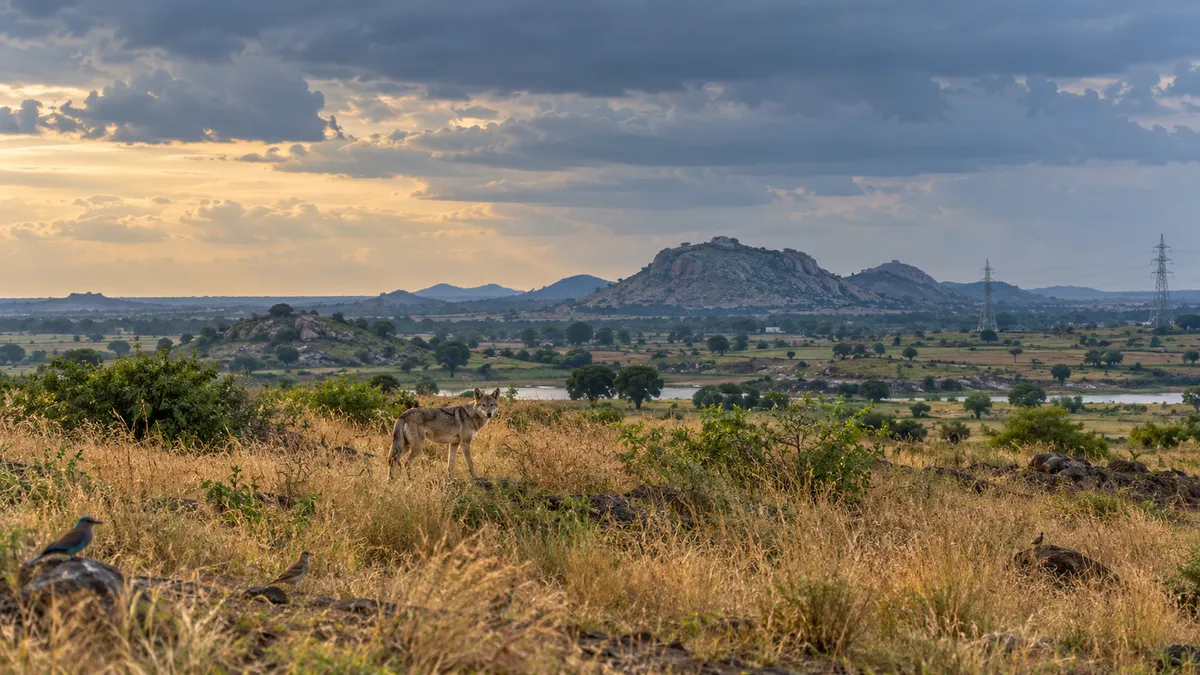
Image credit: AI-generated with OpenAI ImageGen for Humming Genesis; illustrative, not a documentary photograph.
A landscape does not have to be covered in trees to be alive. In Karnataka’s drier districts, open grasslands, thorn scrub, rocky plateaus and fallow fields can look sparse beside the lush Western Ghats. From a car window, they may appear to be places waiting for something better to be built. For wildlife adapted to open country, however, these are not failed forests. They are home.
The word “wasteland” has often done quiet damage to such places. It suggests that land without dense tree cover has little ecological value and can be planted, built over or converted without much loss. But open habitats support their own communities of plants, insects, reptiles, rodents and birds. They also provide feeding and movement space for animals that cannot simply move into a closed-canopy plantation.
Karnataka’s open-country wildlife includes species such as blackbuck, best known from the Ranebennur sanctuary in Haveri district; the Indian wolf, which surveys have found mostly in the drier plains of the north-east and largely outside protected areas; and grassland and scrub birds such as coursers, harriers and sandgrouse, with the exact mix changing by region and habitat. These animals depend on a mosaic: patches of grass, low shrubs, bare ground, rocky outcrops, seasonal water and agricultural land. A uniform plantation can increase the number of trees while reducing the variety of habitats available to species that evolved in open landscapes.
This is one of the difficult truths in conservation: more green is not always more ecological. Tree planting can be valuable where native forest has been cleared and natural regeneration is appropriate. But planting trees across natural grasslands or scrub can alter the habitat rather than restore it. At Ranebennur, plantations of eucalyptus and other trees on the sanctuary’s grassland “blanks” have been listed among the main threats to its open habitat. The first question should be what the land is, not what colour we would like it to be on a satellite image.
Open-country habitat also asks us to be more careful with the word restoration. If a site has been degraded by invasive plants or erosion, intervention may help; if it is a naturally open grassland, covering it with trees can erase the very conditions that support its wildlife. The distinction cannot reliably be made from a photograph or a quick visit in one season. Ecologists need to look at plant communities, soil, wildlife use and the history of the site, while local herders and residents can explain how it changes through the year. That knowledge should inform plans for grazing, fire management, fencing and development. It is especially important when proposals are described as “green” because they involve tree planting or renewable energy. The question is not whether a project has environmental benefits in general, but what it does to this particular landscape and the species that depend on it.
Open habitats are also under pressure from multiple directions. Roads and expanding settlements divide them. Intensive agriculture can remove the uncultivated margins that wildlife uses. Fencing can obstruct movement. Invasive plants may change the structure of grassland. Power infrastructure and other development can introduce collision or electrocution risks for some birds. Renewable energy is necessary for climate action, but siting and design still matter: projects should avoid critical habitat and migration routes, and cumulative impacts should be assessed rather than treating each project as an isolated footprint.
The solution is not to freeze the countryside or ask rural communities to carry the cost of conservation. These are working landscapes, used for grazing, farming, fuel, movement and local livelihoods. Good conservation begins by recognising those uses and identifying where they can coexist with wildlife. That might mean keeping key patches unfragmented, maintaining traditional grazing patterns where evidence supports them, protecting seasonal wetlands, reducing dangerous fencing or retrofitting infrastructure to make it safer for wildlife.
It also means getting the classification right. Before a parcel of open land is declared degraded, officials and developers should ask ecologists and local residents what it supports across seasons. A dry field in April can look empty; after the monsoon it may host flowering plants and insects, nesting birds and prey species. Some habitats are most visible when they are green, others when the grass is short or the rocks are exposed. A single site visit can miss the pattern.
For the same reason, conservation targets should not focus only on forest cover. The condition and connectivity of grassland, scrub and other open habitats need to be mapped and monitored too. Wildlife corridors are not exclusively forest corridors. For animals moving through dry landscapes, a chain of scrub patches, grazing areas and open ground may be just as important as a continuous canopy is for a forest species.
There is a practical role for ordinary observation. Notice the difference between a planted roadside verge and a naturally varied patch of scrub. Look for flowering grasses, termite mounds, tracks, burrows and birds hunting over open ground. Ask whether the land is truly unused or simply used in ways that are less visible to a city resident. These observations do not replace ecological surveys, but they can challenge the assumption that an open landscape is empty.
Policy needs to follow that humility. Environmental assessments should examine habitat function, seasonal use and cumulative fragmentation. Land records and development plans should distinguish natural open ecosystems from degraded land that may genuinely benefit from restoration. Local communities should be included in decisions about grazing, access and management. And restoration funds should go to the right habitat, rather than assuming that every problem can be solved by planting saplings.
Karnataka’s biodiversity is not held only in its famous forests and tiger reserves. It also lives in the less celebrated spaces between them: the rocky hill, the dry grass patch, the scrubby edge of a field. These places may not offer the postcard version of nature. Their value is quieter, and easier to overlook.
The next time a stretch of open country is described as barren, it is worth asking a simple question: barren for whom? A landscape can look spare to us and still be full of relationships, food and shelter. Protecting Karnataka’s wildlife means learning to see that life before the bulldozer, plantation or fence decides the land’s future.
Sources and further reading
- Madhusudan, M. D. and A. T. Vanak. “Mapping the distribution and extent of India’s semi-arid open natural ecosystems.” Journal of Biogeography 50(8): 1377–1387 (2023). https://doi.org/10.1111/jbi.14471
- Singh, M. and H. N. Kumara. “Distribution, status and conservation of Indian gray wolf (Canis lupus pallipes) in Karnataka, India.” Journal of Zoology 270(1): 164–169 (2006). https://doi.org/10.1111/j.1469-7998.2006.00103.x
- BirdLife International and the Key Biodiversity Areas Partnership. “Ranebennur Blackbuck Sanctuary.” Key Biodiversity Area factsheet 18230. https://www.keybiodiversityareas.org/site/factsheet/18230
- Ratnam, J., K. W. Tomlinson, D. N. Rasquinha and M. Sankaran. “Savannahs of Asia: antiquity, biogeography, and an uncertain future.” Philosophical Transactions of the Royal Society B 371: 20150305 (2016). https://doi.org/10.1098/rstb.2015.0305
- Wildlife Institute of India. Power-Line Mitigation Measures to Conserve Bustards, 2nd edition, 2020 (copy hosted by IndiaSpend). https://www.indiaspend.com/h-library/gibpowerlinemitigation.pdf
- Jain, M. “Wastelands or grasslands? India’s history with defining open ecosystems.” Mongabay India, 6 December 2022. https://india.mongabay.com/2022/12/explainer-wastelands-or-grasslands-indias-history-with-defining-open-ecosystems/