One Flat, Six Cats: Keeping the Peace
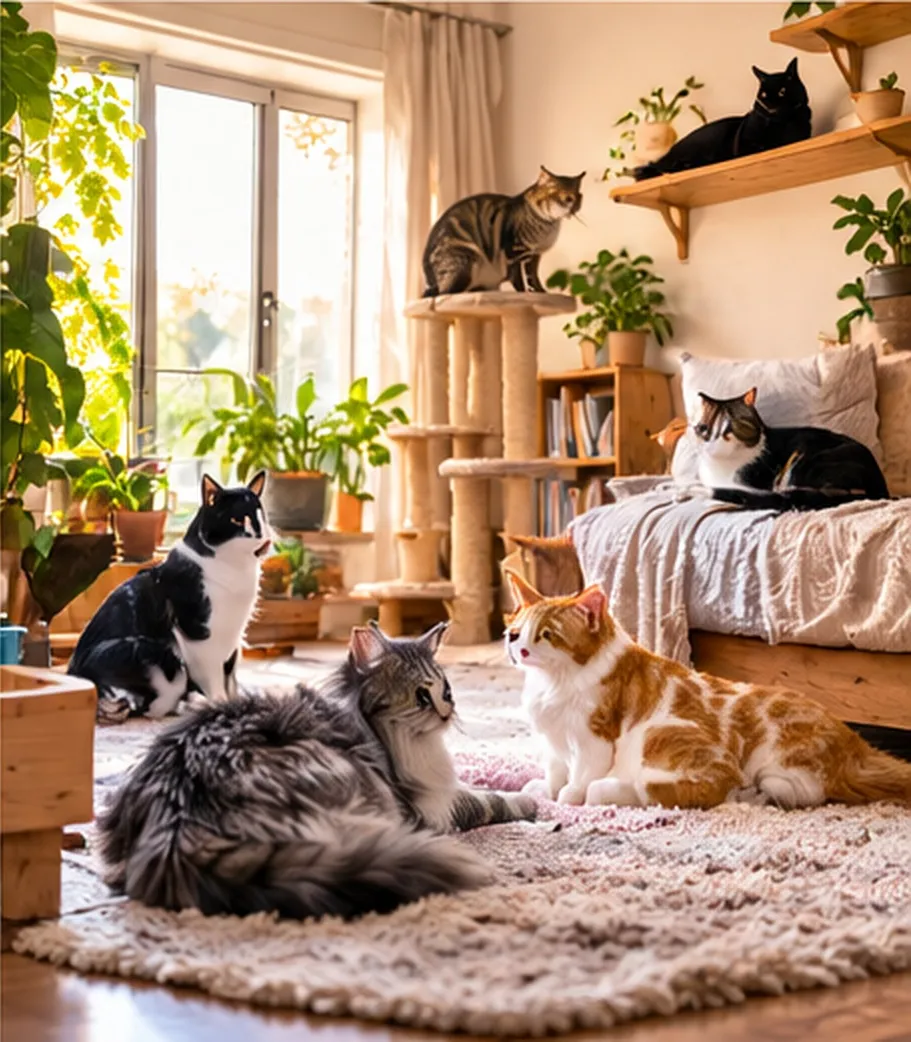
People who hear there are six cats in this flat tend to picture one of two scenes: a sort of feline commune where everyone sleeps in a heap, or a slow-motion civil war. Neither is quite right. What there actually is, most days, is a set of arrangements — negotiated, occasionally renegotiated, and almost entirely about resources.
That is the first thing I wish someone had told me. Cats rarely fight because they dislike each other in some abstract way. They fight, or sulk, or stop using the litter box, because something they need has become scarce or contested. Food, water, a place to toilet, a high place to watch from, a hiding place, a warm spot in the afternoon. When those are plentiful and spread out, most cats will tolerate a surprising amount of company. When they are concentrated in one spot, even cats who like each other start guarding them.
So the rules we follow are mostly arithmetic. More litter boxes than there are cats, in more than one room, because a box in a corridor that one cat can block is not really available to the others. Several water bowls in different places, because a cat who has to walk past a rival to drink will drink less, and cats already drink too little. Separate feeding spots, far enough apart that nobody eats while being stared at.
Height matters more than floor space. A flat is small; its walls are not. Shelves, the tops of cupboards, a cat tree by the window — every vertical level is extra territory, and it lets a cat who wants distance get it without leaving the room. A lot of apparent tension between cats is really one cat with nowhere to go. Give it somewhere up, and the tension often simply stops.
Introductions are where most multi-cat households go wrong, and where I went wrong at first. A new cat dropped straight into a room with residents is an invasion, from the residents' point of view. What works is slow and boring: a separate room for the newcomer, swapping bedding so smells arrive before faces do, feeding on either side of a closed door, then brief supervised meetings, then longer ones. It takes weeks. Rushing it saves days and can cost years of bad feeling.
Then there is watching, which is most of the job. Cats are very good at hiding trouble. The signals are small: one cat who has started toileting outside the box, one who now eats only when the others have left, one who has quietly stopped coming into a room she used to love. Each of those is information about a resource that has become difficult to reach. Fixing the resource usually fixes the behaviour. Punishing the behaviour never does.
Health is the unglamorous part. Six cats means six sets of vaccinations and deworming on a schedule, and it means that anything contagious is everyone's problem. It also means noticing individual change inside a group, which is harder than it sounds: in a crowd of cats, one who is eating a little less can go unseen for days.
None of this feels romantic, and I think that is the point. The peace in this flat is not the product of the cats loving each other, though some of them plainly do. It is the product of making sure nobody has to compete for anything that matters. Get the logistics right and the affection has room to happen on its own.