The Mountain Is Not a Backdrop
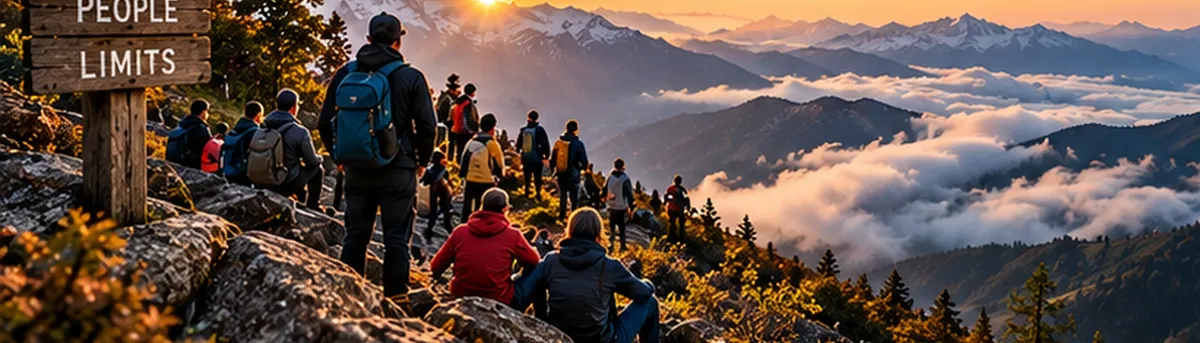
The road to almost any popular hill town now has a season in which it stops being a road and becomes a queue. Cars idling on a gradient for hours, engines running for the air conditioning, in a place people have driven to specifically for the air.
I do not think there is anything wrong with wanting to be in the mountains. I want to be in the mountains. The problem is arithmetic. A town built for a few thousand people, with drainage, water and waste systems built for a few thousand people, receives a few hundred thousand across a few months. Nothing in that sentence requires anyone to behave badly for the outcome to be bad.
Water is usually the first thing to break. Hill towns are fed by springs and small streams with a fixed yield that does not scale with demand, and hotel occupancy uses several times what a resident household does per person. In peak season the tankers start, and the tankers are drawing from the same catchment. Then waste: sewage systems that were marginal at the design population are simply absent at ten times it, and what is not treated goes into the stream that the next town down is drinking from.
Then the slopes themselves. The Himalaya is young, steep and actively rising, which means it is also actively falling down. Cutting into a slope for a wider road or another floor of guest rooms removes the toe support that was holding the material above it. Do that repeatedly along a valley, remove the tree roots that were binding the soil, and then apply the kind of rainfall that is becoming more common, and you get the landslides that now punctuate every monsoon. These are frequently described as natural disasters. The rain is natural. Much of the rest is a construction decision.
What I find hardest is that the pressure is coming from people who genuinely love the place. Mountain tourism is not extractive in intent. It is people wanting, reasonably, to see something beautiful, spending money that the local economy now depends on, in a system with no mechanism for saying: this many, and no more this week.
That mechanism is what carrying capacity means, and it is treated as hostile to livelihoods when it is closer to the opposite. A town whose springs have failed and whose main street has slid into the valley has no tourism economy either. Capping numbers, charging properly for entry into fragile areas, enforcing building rules on slope and setback, requiring waste treatment before permitting rooms — these protect the thing the income depends on.
There is also a quieter question about how we travel when we get there. The same valley can absorb a walker for a week more easily than it absorbs a car for a day. Staying longer in fewer places, using what exists rather than requiring more of it built, going outside the crush of the season: these are not sacrifices so much as a better version of the trip.
The phrase I keep returning to is that the mountain is not a backdrop. It is a working system — of water, rock, forest and the people who have lived with all three for a very long time — and it is currently being asked to perform as scenery for an audience larger than the theatre.