A Lake Is Not a Park With Water in It
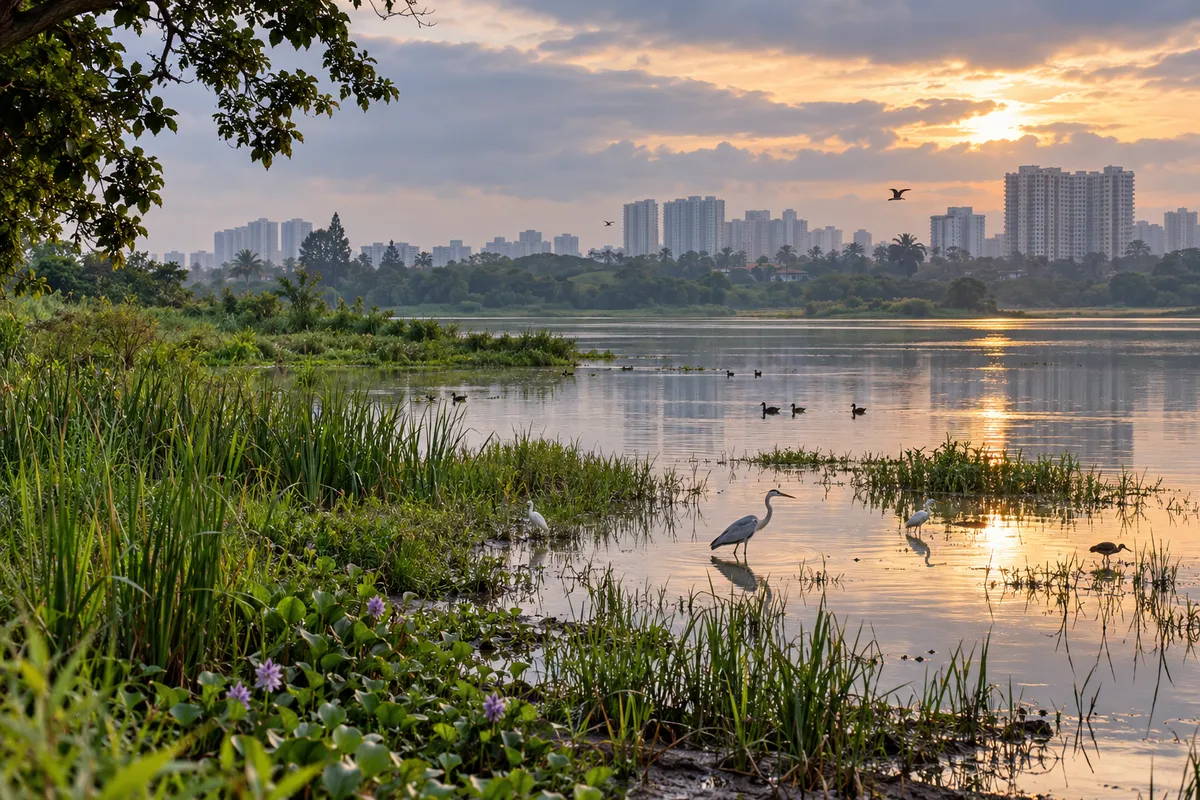
Image credit: AI-generated with OpenAI ImageGen for Humming Genesis; illustrative, not a documentary photograph.
There is a particular Bengaluru morning that many of us know: the lake path is damp, the tea is still too hot to drink, and a white egret is standing so still in the shallows that it looks like a piece of folded paper. Someone is jogging past with headphones on. A dog is tugging at its leash. The city is waking up around a body of water that, for a few minutes, seems to belong to nobody.
But a lake is not simply a pleasant view or a blue patch on a property brochure. It is part of a working landscape. Water moves through it, soil and vegetation filter it, insects and fish feed birds, and the low ground around it gives stormwater somewhere to spread. When we treat a lake as a park with water in it, we risk keeping the view while losing the system.
Bengaluru’s traditional tanks were not isolated ornaments. They were linked, in many places, through channels and valleys that carried excess water from one tank to another. Those connections were practical infrastructure, built into the landscape long before the city’s present scale. Roads, buildings, encroachment and altered drainage have interrupted parts of this network. A lake can be desilted and fenced, yet still be cut off from the catchment that once replenished it.
The distinction matters most when the rain arrives hard. A wetland is not a magic sponge that prevents every flood, and its capacity depends on its shape, soil, vegetation and the amount of water already in it. Still, low-lying wetlands and connected drainage routes can temporarily hold and move water. Paving, filling or narrowing them can push that water into streets and homes instead. The question is not whether a lake looks clean from its walking track; it is whether the wider water system can still do its job.
There is a wildlife story here, too, and it is more interesting than a checklist of birds. Shallow edges, reed beds, open water, mud and scrub offer different kinds of habitat. A heron hunting in the shallows does not need the same conditions as a small bird nesting in a thicket. Dragonflies depend on water during their early life stages. Frogs need suitable breeding sites. Fish and aquatic invertebrates form part of the food web. Simplifying every edge into a neat, steep embankment can remove the very variety that makes a lake alive.
None of this means people should be kept away from lakes. Public access matters. So do safe paths, places to sit and spaces where children can notice a bird without needing a field guide. The problem begins when landscaping becomes the main measure of restoration: trimmed lawns, decorative lighting, concrete edges and a few planted saplings, with little attention to sewage inflows, native vegetation, seasonal water levels or the lake’s connection to its catchment.
The Comptroller and Auditor General’s 2015 performance audit on conservation and ecological restoration of lakes in Karnataka raised concerns about polluted water bodies, weak oversight and poor coordination among the agencies responsible for them. That report is not a description of every lake today, but it is a reminder that restoration is as much about governance and maintenance as it is about a one-time civil works contract. A lake has a life after the inauguration.
What would a more honest lake restoration look like? Start upstream. Map the catchment and the old flow paths before deciding where to build. Stop untreated sewage from entering the water rather than relying on the lake to absorb the consequences. Keep a mix of shallow margins and vegetated patches where appropriate, while ensuring that invasive plants do not take over. Monitor water quality across seasons, not only on the day a project is handed over. Publish the findings in language residents can understand. Make room for local lake groups, ecologists, engineers and people who live downstream to disagree in public and work from the same evidence.
And measure more than footfall. Are sewage inputs falling? Does water persist through the dry months in a way that fits the lake’s ecology? Are native wetland plants returning? Are birds using a wider range of habitats? Does rainwater move through the system without being forced into nearby streets? These questions are less photogenic than a ribbon-cutting, but they tell us whether restoration is working.
A useful test is to ask what happens outside the hours when the lake is busiest. After a heavy shower, does water have room to spread without carrying rubbish into the next neighbourhood? In the dry season, are there still patches of shallow water and vegetation, or has the edge become a hard, uniform wall? When sewage enters, is the source being fixed, or is the lake being asked to dilute it? These are ordinary questions, but answering them requires measurements and maintenance over time. Residents can help record changes, provided observations are not mistaken for laboratory results. Water-quality testing, bird counts and photographs from the same points each season can build a record that is more useful than a single “before and after” image.
There is also a small shift in how we visit a lake that costs nothing. Pause at the edge and look beyond the path. Notice where the water enters, where it leaves, whether the bank changes from grass to reeds to mud, and which birds use each part. A lake is not scenery placed inside the city. It is one of the ways the city lives with water.
Bengaluru does not need every lake to look wild, and it does not need every lake to look manicured. It needs to stop confusing neatness with health. The most successful lake may not be the one with the prettiest promenade. It may be the one that quietly holds rain, supports life and gives the neighbourhood a little more room to breathe.
Sources and further reading
- Comptroller and Auditor General of India. “Performance Audit on Conservation and Ecological Restoration of Lakes under the Jurisdiction of Lake Development Authority and Urban Local Bodies,” Karnataka, Report No. 1 of 2015. https://cag.gov.in/ag1/karnataka/en/audit-report/details/12412
- Ramachandra, T. V., Vinay S. and Bharath H. Aithal. Frequent Floods in Bangalore: Causes and Remedial Measures. ENVIS Technical Report 123, Indian Institute of Science, 2017. https://wgbis.ces.iisc.ac.in/biodiversity/pubs/ETR/ETR123/index.html
- Ramachandra, T. V. et al. Vanishing Lakes Interconnectivity & Violations in Valley Zone: Lack of Co-ordination among Para-State Agencies. ENVIS Technical Report 85, Indian Institute of Science, January 2015. https://wgbis.ces.iisc.ac.in/biodiversity/pubs/ETR/ETR85/index.html